

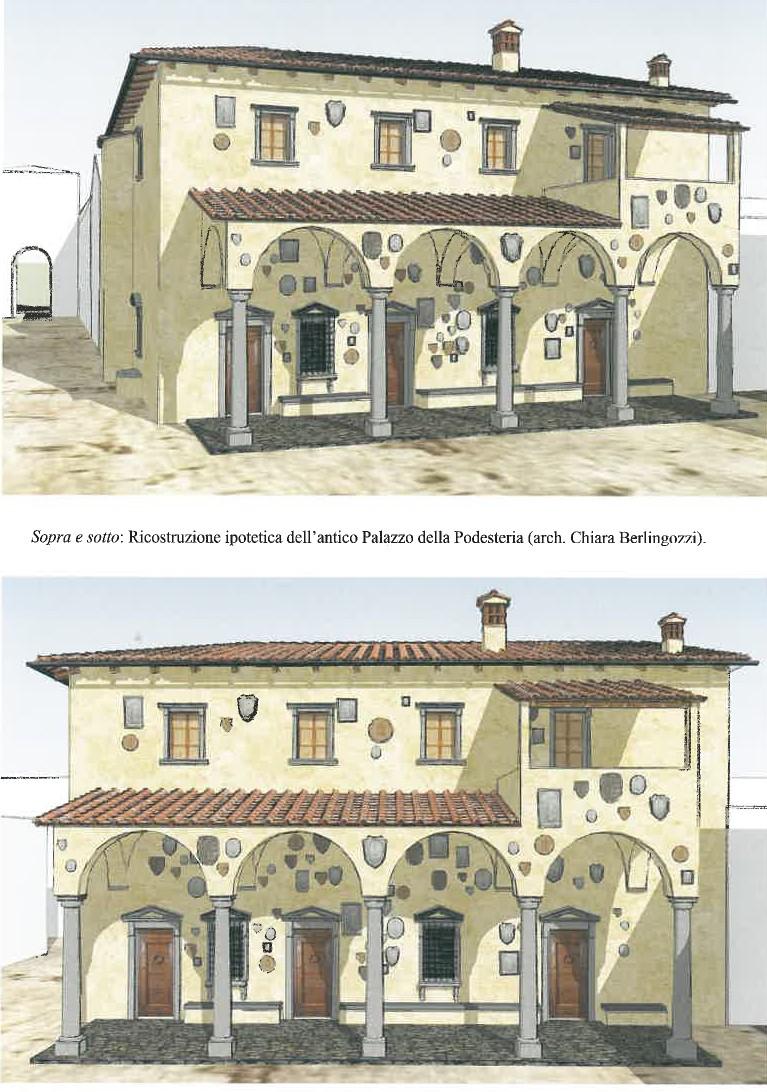
The Podestà, whether during the Florentine Republic or under the Grand Duchy, was appointedby the Florentine authorities per via di tratta, that is, by drawing lots from a selection of eligiblecitizens.
Once appointed, he arrived in office with letters of commission, usually assuming duties alongsidethe new six-monthly council.
In the Florentine statutes of 1415, the Podesteria of Terranuova was classified as first grade.
The Podestà’s residence was located in the center of the terra nuova, in a palace with a loggia projecting over the main square where public auctions were held. Proclamations and ordinanceswere posted on its columns.
On the ground floor was the courtroom where the Podestà heard civil cases, with adjacent rooms for his attendants and the prison.
Like many grand residences, the palace also featured a well with pulley and rope for drawing water. The upper floors housed the council hall and the Podestà’s private apartment.
On the façade and columns of the loggia, each official customarily displayed his family coat of arms and the date of his term.
When the building became the seat of the new comunità (local council) established in 1774, it wascompletely renovated beginning in 1845, and most of these coats of arms were removed. The Iacopi family emblem—depicting a Cinta Senese pig—was recently recovered and placed in a hall of the new town building; two columns bearing carved arms were transferred to the new Council Chamber in the former “White Robe” church.
In earlier centuries, the Podestà also had a private vegetable garden near Porta San Giorgio, besidethe town walls—on the site where, in the early 1600s, the Benedictine convent of the Santissima Annunziata (today the Oratory of San Benedetto) was later built.
Upon arrival in Terranuova, the Podestà was welcomed at the palace by the local standard-bearer(gonfaloniere), presented his credentials to the communal chancellor or a notary, swore allegianceto the statutes in the parish church, and formally took office.
The council of the Podesteria was responsible for maintaining roads connecting the constituentcommunities, building and repairing bridges, ensuring water supply and the efficiency of fountainsand wells, allocating taxes for public works, and managing all other matters within its competence.
Occasionally, conflicts arose between local councils and the Podesteria, particularly over expensesand taxation, sometimes requiring appeals to higher magistrates to ensure equitable distributionamong the territories under its jurisdiction.
Each popolo (parish community) had a seat in the council, either independently or as part of a shared municipality.
The municipality of Terranuova, for example, consisted of the five popoli of Pernina and Cave (together), Ganghereto, Mori, Pozzo, and Terraio; others included Anciolina, Chiassaia, Faeto, Pratovalle, and Poggio (associated with Loro).
Each municipality had its own administrative council headed by a gonfaloniere and a camarlingo (treasurer), renewed every six months through the system of nomination and drawing by lot.