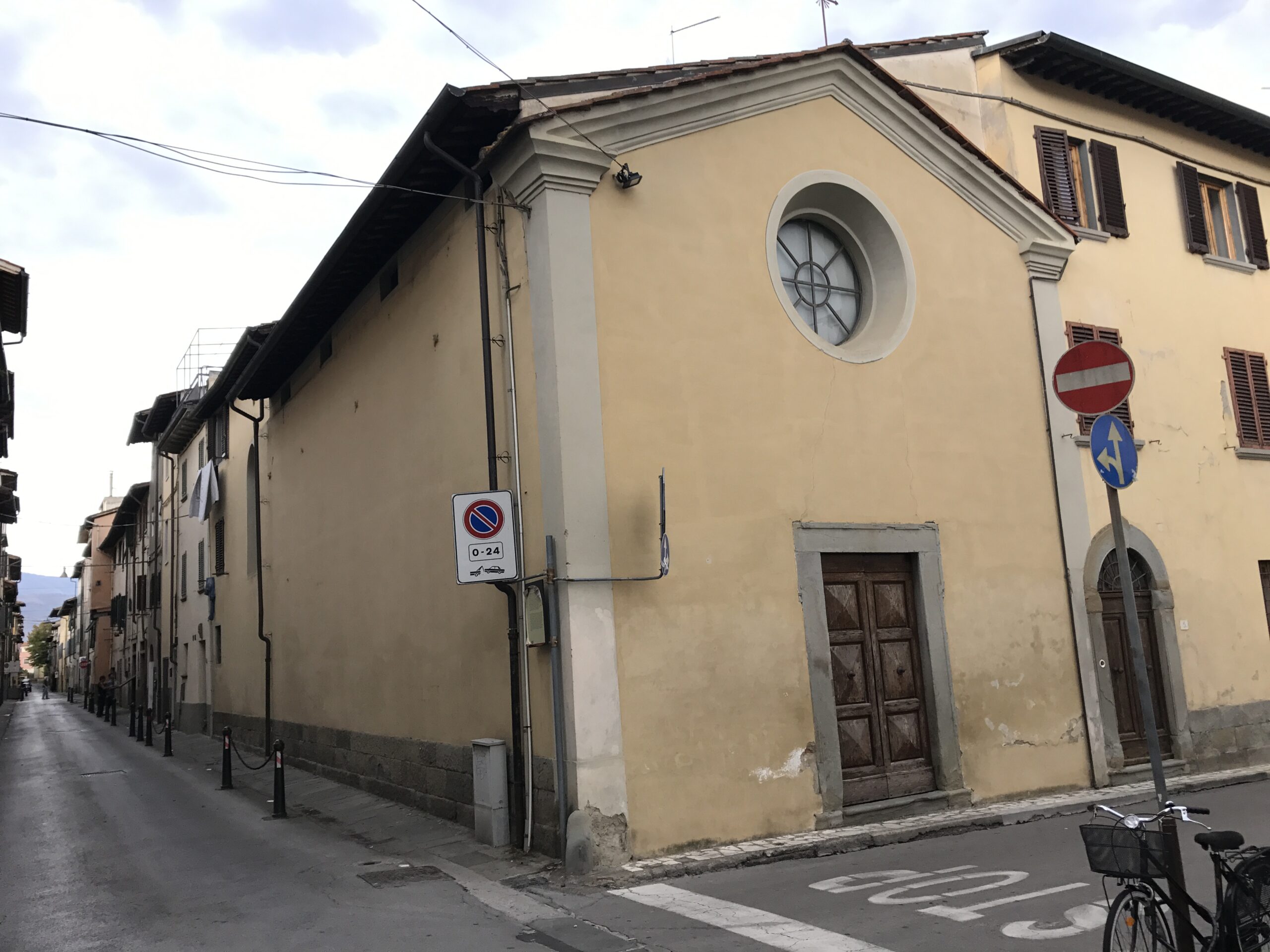
The Church of San Biagio was built, like the others in the new walled town, by the people of the Mori, who dedicated it to Saints Biagio (Blaise) and Paul. The construction and embellishment of the building must have continued over time, as indicated by the epigraph engraved on the architrave of the rectory’s doorway, which bears the dates 1382 and 1737.
The church still shows traces of the many interventions it underwent through the centuries, yet it is the only sacred building in town that preserves much of its original 14th–15th-century painted decoration. The interior consists of a single nave with a vaulted ceiling and a small dome above the main altar, flanked by two lateral altars.
The 14th-century frescoes are arranged along the longer walls; the oldest, dating to 1385, are on the right. Some of these frescoes, only recently brought to light, are divided into several panels: the first depicts Saint Lucy, recognizable by the signs of her martyrdom, followed by Saint Peter enthroned, Saint Michael the Archangel weighing the souls of a just man and a sinner, Saint Anthony the Abbot, and a fragmentary image of an unidentified female saint.
At mid-wall stands a small stone aedicule or chapel dating to the 16th century, with a coat of arms bearing a cross with five stars. Here once stood an altar dedicated to Santa Maria degli Angeli, adorned with a painting of the Madonna and Child between Saints Francis and the young John the Baptist, attributed to Andrea del Sarto (now preserved in the Episcopal Palace of Arezzo). Two frescoed female figures flank the chapel: to the left, Saint Anne portrayed as an elderly woman; to the right, Saint Catherine of Alexandria with her wheel.
On the opposite wall, another cycle of frescoes dated 1388 is interrupted by a 17th-century altar dedicated to Saint Charles Borromeo. The first panel depicts the Virgin and Child seated on a Gothic-style throne, flanked by Saints John the Baptist and Blaise; the following one shows Saint Bartholomew. Beyond the altar, another panel features an image of Saint Lucy.
The stone altar, classical in style, bears on the arch’s moulding an inscription honoring Saint Charles Borromeo and on the right column’s plinth the date 1612. As noted in the pastoral visit of Sebastiano Maggi in 1830, this altar was originally dedicated to the Presentation of the Most Holy Annunciation. The same document records that above it hung a large oil painting of Saint Charles Borromeo praying before the Crucifix, dating to around 1610, now kept in the sacristy of the parish church of Santa Maria Bambina.
In the presbytery stands a Tuscan-made wooden choir. On the wall to the right of the high altar, a 15th-century fresco depicts the Madonna enthroned with the Child, Saint Raphael the Archangel with Tobias on the left, and Saint Romuald on the right. The author is unknown: some attribute the work to the Terranuovese painter Fra Diamante, pupil and collaborator of Filippo Lippi, while others ascribe it to Francesco d’Antonio.
The main altar once held a tempera on panel of the Madonna and Child enthroned, likely the central part of a polyptych, painted by Mariotto di Cristofano (Masaccio’s brother-in-law). This work is now preserved in the nearby modern church of Santa Maria Nuova, designed by Mario Botta and consecrated in 2010. Recently, fragments of frescoes with figures and geometric motifs have also been uncovered on the wall to the left of the main altar.