
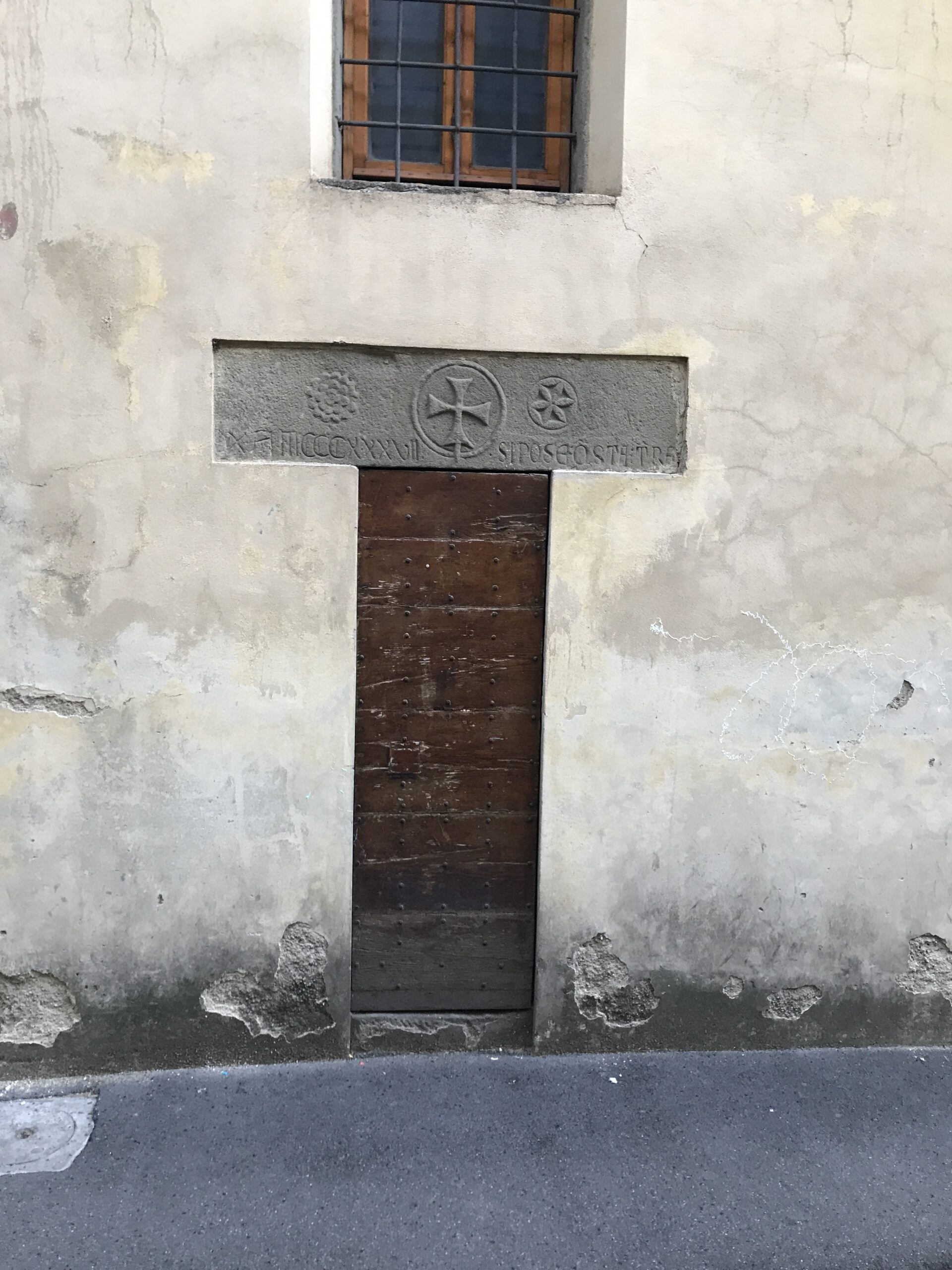
The church, dedicated to the Nativity of the Virgin, was erected by the people of Castel Santa Maria as the church of the entire community and therefore occupied a space considerably larger than those of the individual parishes. An inscription on the left side of the building marks the founding date of the terra nuova (new town):
(X[risti] A[nnis] MCCCXXXVII SI POSE Q[ue]STA T[er]RA) – In the year of Christ 1337 this town was founded.
Initially under the jurisdiction of the parish of Gropina until 1443, it later became a pieve (parish church with baptismal rights) and the mother church of all Terranuova’s parishes—likely through the influence of Poggio Bracciolini, papal secretary. In 1737, it was elevated to the rank of archpriesthood.
The church’s current appearance results from major restoration works carried out between the 16th and 18th centuries.
Inside, it has a single nave with a vaulted ceiling and a triumphal arch giving access to the presbytery. Along the side walls are six stone altars, each flanked by two imposing columns supporting an entablature with a broken pediment motif. These altars, like the main one, were probably built in the early 17th century, as suggested by the inscription beneath the altar of the Chapel of the Madonna del Rosario, dated 1616. On the right side of the counter-façade stands the baptistery, with a pietra serena basin and a painting of the Baptism of Christ.The first altar on the right is that of Saint Lucy, originally dedicated to the Annunciation, as indicated by an inscription above. It was commissioned by Poggio Bracciolini, who also had a fine Latin epigraph carved beneath the altar in littera antiqua, dated 1438, narrating the discovery of important relics—one of the earliest examples of Humanistic script. The second altar is dedicated to Our Lady of Good Counsel and originally belonged to the Bartolini Baldelli family, as shown by two marble coats of arms at the base. Next is the altar of the Assumption, decorated with two stone coats of arms, one surmounted by a cardinal’s hat. Above it hangs a canvas depicting the Assumption of the Virgin with Saints Anthony of Padua and Joseph.
On the left side of the counter-façade stands a polychrome terracotta group of the Nativity, sculpted by Agnolo di Polo.
The adjacent altar, dedicated to Saint John the Evangelist—also known as the altar of the “Holy Marys” or the “Deposition”—holds another polychrome terracotta group representing the Pietà, also by Agnolo di Polo.
Nearby is the Rosary Altar, built by the women’s confraternity devoted to the Rosary. Above it is a large painting depicting Our Lady of the Rosary with Saints, Angels, and the Fifteen Mysteries framed within a painted architectural base.
Next comes the Holy Trinity Altar, under the patronage of the Concini and Ricasoli families, whose coats of arms appear on it. The painting above, dating to the late 17th century, represents the Holy Trinity with Saints Francis and Clare.
Higher up on both side walls hang four 18th-century paintings depicting heroines from the Old Testament: Esther before Ahasuerus, Judith showing Holofernes’s head to Achior, Boaz with Ruth, and Deborah before the tent of Jael, with Sisera dead at her feet.
In the presbytery, on either side of the main altar, two 18th-century oil paintings portray the Virgin and Saint Titus, respectively.
Beneath the main altar lies a wooden urn containing the body of Saint Titus, martyr, whose relics were brought to Terranuova from the Catacombs of Saint Priscilla in Rome in 1665.
The sacristy and rectory preserve several notable works, including Christ and the Samaritan Woman at the Well by Giovanni Martinelli, dated 1638.