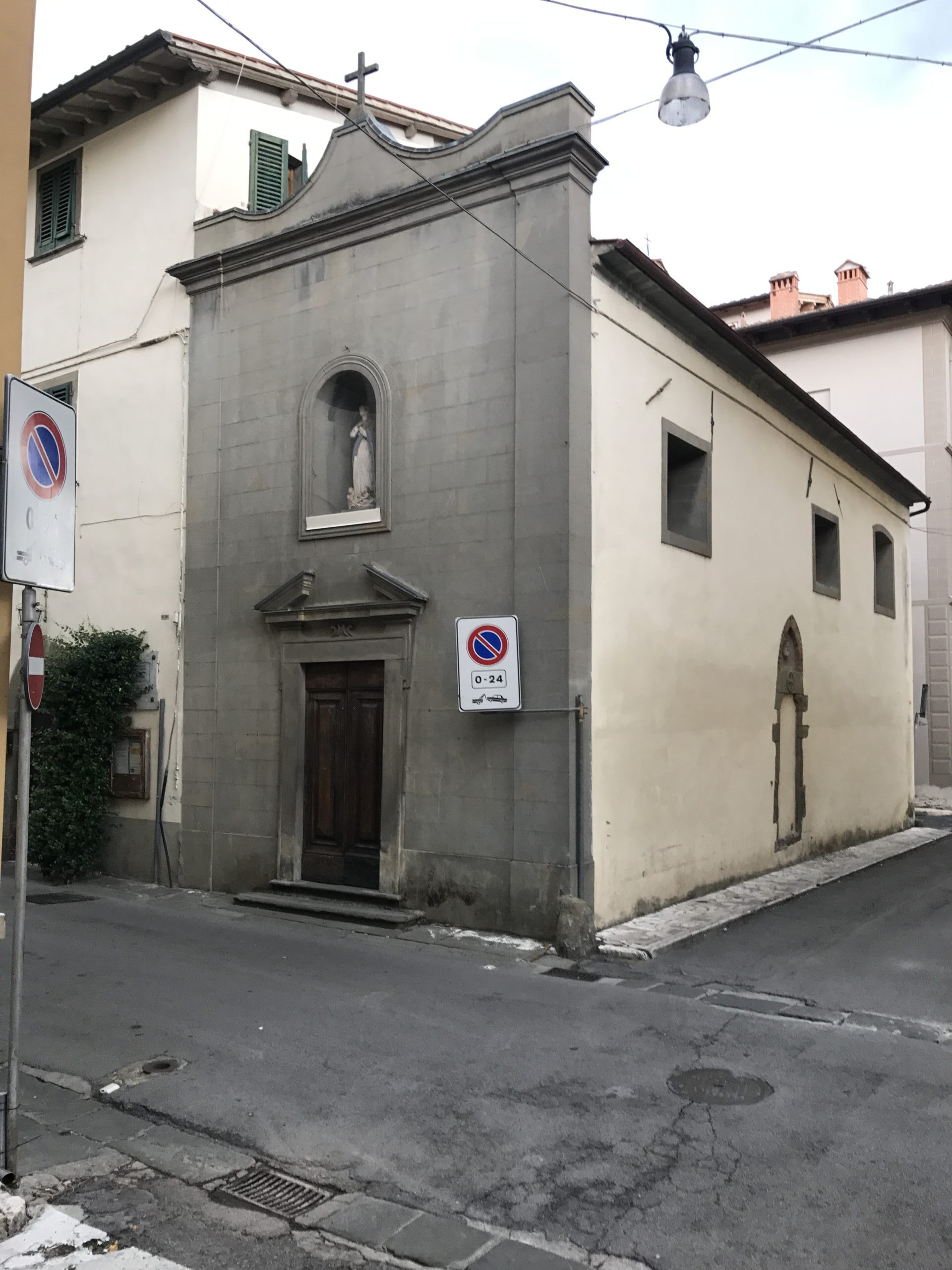
The small Church of Santa Maria in Pernina also dates back to the medieval period, but unfortunately, of its original structure only the walled-up portal opening onto Via Mazzini survives. This doorway features a monolithic lintel, a Templar cross, and a terracotta Madonna and Child — symbols of the former community of Castel Santa Maria.
The church’s current interior appearance results from restoration work carried out in the first half of the 20th century, which removed the late Baroque excesses. The entrance portal on Via Concini recalls 18th-century style through its broken pediment motif. Above it, a window houses a terracotta statue of the Virgin by the Franciscan sculptor Giuseppe Galli from Signa. The interior is very simple, consisting of a single nave with a vaulted ceiling. The lateral walls are articulated by two false portals in stucco imitating stone and marble, both characterized by broken pediments (18th century). Here are placed marble cenotaphs commemorating Terranuova citizens who died during the 19th-century cholera epidemic and were buried beneath the arcades of the Sanctuary of Pernina, where identical inscriptions can still be seen.
Above the high altar hangs an oil painting representing the Assumption of the Virgin Mary—to whom the church is dedicated—dating from the second half of the 18th century.
The work is of modest execution, repeating archaic models rendered in an almost vernacular style. To the left of the altar, inside a painted stone tabernacle, is the Latin inscription: Isti sunt sancti qui laverunt stolas suas in sanguine Agni (“These are the saints who have washed their robes in the blood of the Lamb”), dated 1583.
Today, this sacred building is known as the Church of the Misericordia. The Confraternity of Mercy had its headquarters in the rectory from 1855 until its recent transfer to the new premises in Via Dante, near the “Farewell Chapels,” where several artworks formerly kept in the church’s sacristy have also been moved.